
Every year, many students memorise pages of formulas, definitions and solved examples, and still find themselves stuck in the exam hall. The question looks slightly different from the one they practised, and suddenly nothing they memorised seems to fit.
The problem isn’t effort. It is rote learning: remembering answers without understanding why they work. In maths and science especially, understanding concepts is what turns hard work into good results.
What is the difference?
Rote learning means repeating information until it is remembered: “the area of a circle is πr²”, “acids turn blue litmus red”. It answers what.
Conceptual learning means understanding the idea behind the fact: why the area of a circle depends on the square of the radius, or what actually happens when an acid reacts with an indicator. It answers why and how.
Some memorisation is useful. You need to know formulas, symbols and definitions. But memory should rest on understanding, not replace it.
Why rote learning fails in maths and science
1. Questions keep changing
Board papers no longer ask only textbook questions word for word. Both the SSC and CBSE boards include application-based and higher-order questions that present a familiar concept in an unfamiliar way. A student who has memorised one method for one type of question has nothing to fall back on.
2. Topics build on each other
Maths and science are like a staircase. Class 10 algebra depends on Class 8 and 9 algebra. Chemical reactions depend on understanding atoms and valency. A memorised topic is a weak step, and everything built on it becomes shaky too.
3. Memorised facts fade quickly
Facts learned without meaning are forgotten within weeks, which is why students who cram often need to “learn everything again” before every exam. Concepts that are understood stay much longer, because they connect to other ideas.
4. It builds fear, not confidence
When a student doesn’t understand why something works, every new problem feels like a threat. This is where much of the “I’m bad at maths” feeling begins. Understanding replaces fear with confidence.
What conceptual learning looks like
In maths
Take the Pythagoras theorem. A rote learner remembers “a² + b² = c²”. A conceptual learner knows it only applies to right-angled triangles, can explain why with a diagram, and can therefore use it to find the height of a ladder against a wall, the diagonal of a rectangle, or the distance between two points on a graph, even when the question never mentions Pythagoras.
In science
A rote learner memorises “the moon has phases”. A conceptual learner understands that the moon reflects sunlight and we see different portions of its lit half as it orbits the Earth, and can therefore explain an eclipse, a full moon, or why the phases repeat roughly every month.
How students can learn conceptually
- Ask “why?” often. Whenever you learn a formula or rule, ask why it is true and when it applies.
- Draw it. Diagrams, graphs and flowcharts make abstract ideas visible.
- Connect it to real life. Look for where a concept shows up around you: speed in a car, pressure in a cooker, percentages in a sale.
- Explain it aloud. If you can teach a concept to a friend or family member in simple words, you understand it.
- Solve varied problems. Don’t repeat the same type of question. Mix question types so you learn to recognise which concept applies.
- Learn from mistakes. When you get a question wrong, find out which idea you misunderstood, not just the correct answer.
How parents can help
- Ask your child to explain what they learned today, instead of asking only about marks.
- Value questions. A child who asks “why?” is thinking, not being difficult.
- Be patient with slower progress at first. Understanding takes longer than memorising, but it lasts much longer.
- Choose teachers and classes that explain, not just dictate notes.
Understanding first, then practice
Conceptual learning doesn’t mean less practice. It means practice that makes sense. Once a concept is clear, regular problem-solving makes it fast and accurate, and that combination is what produces strong board results.
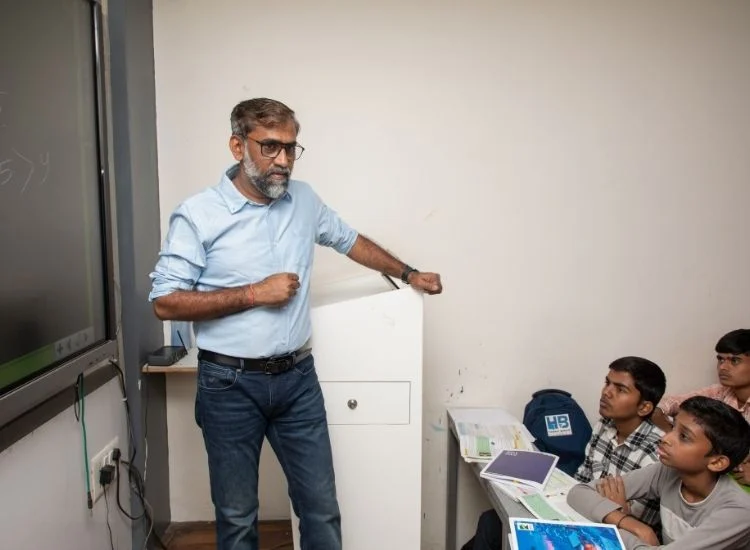
At Hemant Bora’s Academy, this is how we teach maths and science. We turn complex theories into simple, visual concepts using smart boards and real-life examples, then strengthen them through weekly tests and personal doubt-solving. See our courses for Classes 8, 9 and 10 (SSC and CBSE), or visit our Wadgaon Sheri or Chandan Nagar branch for a free counselling session.

Written by Hemant Bora's Academy
Academic Contributor